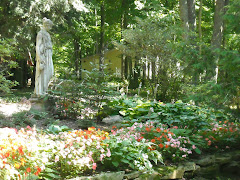
What is it that draws us outdoors? What is it that compels us to plant a garden, or landscape our homes, or hike a national park? For the past two weekends I have spent my leisure time in the front yard of my house re-landscaping with my wife. We are on a mission to correct the flaws that we have tried to ignore for the last five years since purchasing our home. We had made a decision, and before I could say "pass the ibuprofen", we were cutting sod, tilling the soil and creating new planting beds. Our driveway is now a holding area of compost & mulch piles and containers of shrubs and perennials. Together we labored to create a more ideal environment, or to say it better, our own private Eden.
The Garden of Eden has long been synonymous with paradise on earth. …A paradise lost. I asked Pastor Lou Rossetti of Wausau Alliance church about the Biblical connection of this underlying attraction we have for nature. He referred me to the first book of Genesis Verses 28 and 29 which covers the command that God gave man to have dominion over the earth. The word dominion according to Merriam Webster is defined as; domain, supreme authority or sovereignty. The command that God gave Adam was to tend the garden; so in essence, we are all ancestors of the very first gardener. The positive feelings that we get from spending time in the great outdoors is a direct link to our DNA. How cool is that?
Now while I am on the subject of the pursuit of paradise, I would like to address something that I refer to as; "The paradox of the project". Often times during the design process, we will inventory the wish list of a client, along with the needs of the site. We will then draw a detailed plan and present it along with a proposal for the work. What often happens is that the client will go into analysis paralysis. They now have a road map to their desires, but the reality of the price sends them into an altered state. There are two important things to remember here. First, never limit your possibilities due to a perceived price or budget. This is where real creativity comes into play - Getting the desired result even with a less than desirable budget. A wise man once posed this question to me. Sure there is a price to pay, but what is the cost of not doing it? And second, understand that your project can be implemented in phases. Doing things well, and at a pace that you can cope with will allow you to have quality craftsmanship and materials, and an outstanding result. And over a time line that you can live with. (Typically three to five years). I often recommend that our clients only implement what they are truly comfortable with. After all, what good is your piece of paradise if you are financially stressed by it? Eat the elephant in small bites.
The bottom line is that things of beauty often take time. The Good Lord did it in six days, but we aren't that good. However, with planning, patience and an "it's possible" attitude, you are well on your way to creating your own private Eden.
James Merritt/ Living Color Landscapes
715-849-9600
www.livingcolorlandscape.net
Blog comments to this article at www.lifeandlandscapes.blogspot.com
Sunday, July 27, 2008

Monday, July 21, 2008
Love Lives Here
We got a call yesterday for an impromptu dinner invite to the home of some now dear friends. Not being one to stray too far from a good meal, I have learned from the few previous times when I was blessed by their hospitality that this is one invitation not to pass up! The secret is excellence. Plain and simple. Love lives at that address and it makes a regular appearance in the form of food and fellowship severed generously at the Lombardo's.
I have asked them to become bloggers and to stop in and share the goodness of their kitchen. I have managed to beg a few recipes from the Lombardos and will get busy and post them. However, the real good stuff is yet to be revealed. This is a definite treat and the wonderful preparation of fine Italian delicacies from family recipes dating back generations should be shared with food enthusiasts everywhere. This is a gold mine folks and I hope that it will spark a mother load from others out there in the world.
Hey - Did I mention that I love Thai food... Anybody out there?
I have asked them to become bloggers and to stop in and share the goodness of their kitchen. I have managed to beg a few recipes from the Lombardos and will get busy and post them. However, the real good stuff is yet to be revealed. This is a definite treat and the wonderful preparation of fine Italian delicacies from family recipes dating back generations should be shared with food enthusiasts everywhere. This is a gold mine folks and I hope that it will spark a mother load from others out there in the world.
Hey - Did I mention that I love Thai food... Anybody out there?
Tuesday, July 15, 2008
The Idea Garden
OK, I knew a guy who once knew a guy, who worked for the next door neighbor of the guy who invented the internet. So I feel that I have an inside track on this technology thing.
We are planting a garden here. I am encouraging friends and strangers alike to check in, add your wisdom and contribute to the Idea Garden.
We are looking for Martha Stewart type tips, We are looking for the Killer Tomato story, we are looking for healthy alternatives to the junk that we as a nation consume. We are looking for cures, and anecdotes and Grand Ma's pickling recipe. We are looking for things that feed the spirit and the belly. I know that many of you have it in you.
Yes we are busy. Yes we have the 5 second mentality with all things internet, but this is a project that will grow on you. As I had mentioned, I will be posting the articles that I write for the Wausau Daily Herald as they are published, but that is only part of the story. You make up the rest.
So bust loose with the good stuff. Be a blessing to others and share your goodies.
Want a great Kahlua turkey recipe? - "It's da kine bra"!
Stay tuned -
Aloha,
Motor
We are planting a garden here. I am encouraging friends and strangers alike to check in, add your wisdom and contribute to the Idea Garden.
We are looking for Martha Stewart type tips, We are looking for the Killer Tomato story, we are looking for healthy alternatives to the junk that we as a nation consume. We are looking for cures, and anecdotes and Grand Ma's pickling recipe. We are looking for things that feed the spirit and the belly. I know that many of you have it in you.
Yes we are busy. Yes we have the 5 second mentality with all things internet, but this is a project that will grow on you. As I had mentioned, I will be posting the articles that I write for the Wausau Daily Herald as they are published, but that is only part of the story. You make up the rest.
So bust loose with the good stuff. Be a blessing to others and share your goodies.
Want a great Kahlua turkey recipe? - "It's da kine bra"!
Stay tuned -
Aloha,
Motor
Monday, July 7, 2008
"The Healing Garden"
"There are no weeds", my teacher proclaimed as we walked through the meadow that was the original encampment of the Menominee people. The beauty of this moment was only matched by the gentle reverence in his voice as he continued "Everything has its purpose, the Creator placed these gifts for us to use." He smiled as he continued... "It was the Europeans that named them weeds. To us, (The Menominee) they are medicine. One just needs to know how to use them." He took his pocket knife out and cut off a slice from the stem of a Staghorn Sumac and gave it to me. "Put this in your mouth, and park it like a cough drop. It is an excellent remedy for a sore throat". Everywhere I looked I was instructed how these gifts from the Great Spirit were placed here to help us, either as food or as medicine.
My teacher was a man named Marvin "Steve" Askinette. A tribal elder, my friend and a wonderful story teller. Standing there in that prairie some fourteen years ago, my eyes were opened to generations of rich information. It is amazing just how much we don't see. Maybe it is a result of our need to have everything neat and clean, maybe it is our controlling nature, but the answers to many of our problems are as near as the backyard.
I wrote recently about "weed" control. The thing that comes to my mind is the war we have waged against the Dandelion. This "menace" to our perfect lawns turns out to be one very potent healer. From Native America, to Appalachia, to the Great Wall of China, tonics, teas and tinctures made from this plant are known to support digestion, work as a blood purifier, relieve constipation, joint pain, inflammatory skin conditions, and is a powerful remedy for liver problems, including conditions such as hepatitis and jaundice. This is only the beginning of our journey into the over-looked and misconceived. Did you know that the much-hated Stinging Nettle is a medicinal food packed with micro nutrients and minerals? The list goes on, beyond the ugly and disdained to the beauties that inhabit our flower gardens. Much loved specimens such as Monarda, Echinacea, Liatris, Balloon Flower, and, Snake Root are often used in landscape designs for their perennial interest. However they also provide a valuable array of healing properties that are mostly unknown to their owners. The immune system builder Goldenseal is in such demand that it is being over harvested, making it one of the most expensive herbs on the market. The good news is you can "grow your own" right here in your shade garden. I found an incredible resource for medicinals where I counted over 120 varieties of healing plants that grow in USDA climate zones 3 and 4. Visit Crimson Sage Medicinal plant nursery (www.CrimsonSage.com) or call them at 530.627.3457.
Yes, everything has its purpose. And maybe if we are open to information, whether it is ancient or new, we will ultimately fulfill ours. "Posoh" Steve.
James "Motor" Merritt - Creative Director
Living Color Landscapes - 715-849-9600
www.livingcolorlandscapes.net
My teacher was a man named Marvin "Steve" Askinette. A tribal elder, my friend and a wonderful story teller. Standing there in that prairie some fourteen years ago, my eyes were opened to generations of rich information. It is amazing just how much we don't see. Maybe it is a result of our need to have everything neat and clean, maybe it is our controlling nature, but the answers to many of our problems are as near as the backyard.
I wrote recently about "weed" control. The thing that comes to my mind is the war we have waged against the Dandelion. This "menace" to our perfect lawns turns out to be one very potent healer. From Native America, to Appalachia, to the Great Wall of China, tonics, teas and tinctures made from this plant are known to support digestion, work as a blood purifier, relieve constipation, joint pain, inflammatory skin conditions, and is a powerful remedy for liver problems, including conditions such as hepatitis and jaundice. This is only the beginning of our journey into the over-looked and misconceived. Did you know that the much-hated Stinging Nettle is a medicinal food packed with micro nutrients and minerals? The list goes on, beyond the ugly and disdained to the beauties that inhabit our flower gardens. Much loved specimens such as Monarda, Echinacea, Liatris, Balloon Flower, and, Snake Root are often used in landscape designs for their perennial interest. However they also provide a valuable array of healing properties that are mostly unknown to their owners. The immune system builder Goldenseal is in such demand that it is being over harvested, making it one of the most expensive herbs on the market. The good news is you can "grow your own" right here in your shade garden. I found an incredible resource for medicinals where I counted over 120 varieties of healing plants that grow in USDA climate zones 3 and 4. Visit Crimson Sage Medicinal plant nursery (www.CrimsonSage.com) or call them at 530.627.3457.
Yes, everything has its purpose. And maybe if we are open to information, whether it is ancient or new, we will ultimately fulfill ours. "Posoh" Steve.
James "Motor" Merritt - Creative Director
Living Color Landscapes - 715-849-9600
www.livingcolorlandscapes.net
Tuesday, June 24, 2008
Design for the Times
Like most industry professionals, I have been contemplating how we are going to adjust to the pressures of today's fuel prices. The cost of everything is rising. From the pump to the grocery checkout aisle, everyone is paying the price. Historically, times of crisis and challenge give birth to opportunity and innovation. The way we approach everyday things like landscaping and gardening will gradually change too. I have long felt that the sprawling "Suburban Lawn" concept of the 50's and 60's is an outdated notion. Now before I get arouse the ire of the John Deere Nation, let me explain… There are two things to consider here; Time and resources. Our lives are much more complex today than in the Ozzie and Harriet days of old. The pace is faster, and often times the candle burns at both ends and the middle. Considering your lifestyle, how much time are you willing to spend maintaining your landscape? What is the intended use of your turf area? (Recreation, pets, etc.). Larger lawns require more time, equipment, water and fuel. A solution would be to downsize the lawn area. Create a circular or oval lawn that serves as a lush, green center piece for your landscape and adds further interest with the surrounding planting beds. This is also a great time to address any cosmetic enhancements to your home. Take a look at the sight lines from inside your home. Things like window to window exposure, unsightly storage areas and lighting can all be masked by the proper placement of planting beds and trees. Next, examine the exterior view of your home. Again, the proper placement of trees and planting beds can enhance the architectural features or soften the less desirable views. Once you have an idea of where to plant, now we can begin to consider what to plant. The next question I would pose is… Irrigation or Xericape? With over 32 million acres, our beloved lawns are the largest irrigated crop in the United States. Over one third of residential water usage is consumed in the effort to maintain them. Xeriscape – which is a word derived from the combination of the Greek word xeros which means dry, and landscaping, Wikipedia defines Xeriscaping as "Landscaping in ways that do not require supplemental irrigation". This practice is gaining popularity in the southern regions and in the arid west, and its principals are beneficial right here in the upper Mid-west. Selecting drought tolerant trees, shrubs and perennials from a rather long list, combined with mass plantings of ground covers and adequate coverage of mulch will provide you relief with your water bill. And a final thought… Throw away your bird feeder and go Native! There is a wonderful variety of native shrubs and perennials that attract songbirds, hummingbirds and butterflies. Providing a beautiful spring blooms, summer berries and Vibrant fall color. With proper planning and a bit of imagination, this is a case where less turns out to be much, much more.
James "Motor" Merritt
Partner and Creative Director of Living Color Landscapes
715-849-9600 – www.livingcolorlandscapes.net
James "Motor" Merritt
Partner and Creative Director of Living Color Landscapes
715-849-9600 – www.livingcolorlandscapes.net
Thursday, June 19, 2008
THE SWITCH IS ON – ORGANICS IN THE HOME AND GARDEN
My inspiration this week comes from a half-eaten Newman’s Organic Dark Chocolate bar. (I don’t think that my wife reads this so I feel somewhat comfortable confessing my dietary sins). Anyway, I began to take inventory of the many ways that organic products have found their way into our home. Everything from the foods we eat, to laundry and cleaning products, to skin care; Americans are waking up to the simple fact that less chemical exposure is better for us!
This “new” attitude, (not - for us aging Hippies) is now making its way outdoors into our lawns and gardens. Not only are we giving our kids and pets a less toxic lawn to play on, but the storm water run-off carries less chemicals into our recreational waters, and yes, municipal and ground water too. Then there are the beneficial insects; ladybugs, fireflies spiders, praying mantis, and wasps that combat the destructive insects that devour our plants. It seems that it would be better if we weren’t poisoning these ‘little buggahs’. Recently there is news on the un-explained disappearance of whole colonies of bees. Although many theories are circulating, we shouldn’t rule out environmental pressure and the effects of chemical fertilizers and pesticides. And finally, we eliminate the exposure to ourselves from mixing, broadcasting and spraying of chemicals. That means less dust in our lungs and toxins through our skin. Now, I am not advocating the elimination of one of the American Male’s great spring rituals, as we all have a bit of “The Tool Man” in us. I am simply suggesting that we consider a better approach.
Too often we are treating symptoms that could be prevented by better preparation. Compacted, dry, or inorganic soils give off signals that we often misinterpret. Our typical response is to run down to the home improvement mart and begin throwing chemicals on the problem. Very often, non-chemical solutions such as de-thatching, core aeration, and simply starting with adequate organic based soils (4 to 8” for a healthy lawn) will correct the situation and produce a lush green turf and abundant blooms.
Last week I was speaking with Jeff Nowak; Living Color’s Landscape Management Director. He told me that he made the switch to organics early this year and his clients are seeing dramatic results in just a few short weeks. Nowak said; “You have to see it to believe it. We are getting six weeks of growth from our annual plantings in only two weeks”. “We are now using non-salt and low-salt based fertilizers and the results are significant. At this point, my curiosity began to peak. What is it? And where can I get it?
“We are using Green Guard Plant Starter Plus for shrubs, ornamentals and vegetable gardens and Green Guard 17 – 9 – 7 Low Salt Turf Builder for lawns. These are available, easy to use and virtually fool proof. This is truly a win – win solution with outstanding results. Seems like a great idea to me!
James Merritt / Landscape Designer
www.livingcolorlandscapes.net
This “new” attitude, (not - for us aging Hippies) is now making its way outdoors into our lawns and gardens. Not only are we giving our kids and pets a less toxic lawn to play on, but the storm water run-off carries less chemicals into our recreational waters, and yes, municipal and ground water too. Then there are the beneficial insects; ladybugs, fireflies spiders, praying mantis, and wasps that combat the destructive insects that devour our plants. It seems that it would be better if we weren’t poisoning these ‘little buggahs’. Recently there is news on the un-explained disappearance of whole colonies of bees. Although many theories are circulating, we shouldn’t rule out environmental pressure and the effects of chemical fertilizers and pesticides. And finally, we eliminate the exposure to ourselves from mixing, broadcasting and spraying of chemicals. That means less dust in our lungs and toxins through our skin. Now, I am not advocating the elimination of one of the American Male’s great spring rituals, as we all have a bit of “The Tool Man” in us. I am simply suggesting that we consider a better approach.
Too often we are treating symptoms that could be prevented by better preparation. Compacted, dry, or inorganic soils give off signals that we often misinterpret. Our typical response is to run down to the home improvement mart and begin throwing chemicals on the problem. Very often, non-chemical solutions such as de-thatching, core aeration, and simply starting with adequate organic based soils (4 to 8” for a healthy lawn) will correct the situation and produce a lush green turf and abundant blooms.
Last week I was speaking with Jeff Nowak; Living Color’s Landscape Management Director. He told me that he made the switch to organics early this year and his clients are seeing dramatic results in just a few short weeks. Nowak said; “You have to see it to believe it. We are getting six weeks of growth from our annual plantings in only two weeks”. “We are now using non-salt and low-salt based fertilizers and the results are significant. At this point, my curiosity began to peak. What is it? And where can I get it?
“We are using Green Guard Plant Starter Plus for shrubs, ornamentals and vegetable gardens and Green Guard 17 – 9 – 7 Low Salt Turf Builder for lawns. These are available, easy to use and virtually fool proof. This is truly a win – win solution with outstanding results. Seems like a great idea to me!
James Merritt / Landscape Designer
www.livingcolorlandscapes.net
Tuesday, June 17, 2008
"A Safe Alternative"
Last week I received an email from an old friend who had read my article on spring clean ups. I ended the piece recommending the application of a pre-emergent herbicide, a common practice of professional landscapers and something that I have become comfortable with in commercial landscape applications. This is just the way it’s done, or is it? As my friend Matt Powers, owner of Easton Landscaping so eloquently pointed out; “As landscape professionals I feel we have an ability to influence customers in a number of ways including environmentally responsible approaches to pest management”. This is something that we have been doing at our company, using organic, low salt fertilizers, and avoiding the application of phosphorous around watershed, but I should have offered a safe alternative to chemicals, and I am grateful to Matt for bring this to my attention. Matt went on to say; “We all need to understand that what we put on the ground in our own yard does not stay there, it travels great distances in air and water. When we apply chemicals to our yards we all need to understand that there are consequences…” Consequences like the “Dead Zone” in the Gulf of Mexico, an oxygen depleted area of water equivalent to the total volume of Minnesota’s 10,000 lakes.
With this on my mind, I took a stroll down the isle of a large home and garden retailer Sunday afternoon and found myself in the garden chemical isle. I was amazed by the number of products and began reading the labels, and warnings. …Pretty serious stuff about eyes, and children and pets, and then it hit me… We are caught up in an almost ritualistic habit of dumping chemicals on our lawns and gardens in a quest for the perfect patch of green, all without thinking of the effects downstream. Synthetic pre-emergents like Preen,TR-10, Treflan and a host of others, have been proven to be deadly to fish and in higher concentrations to earthworms.” Powers continued, “What ever happened to pulling the weeds?”
OK, here is the good news! There is a safe alternative to chemicals – Corn Gluten meal. Available in several forms, one from Preen under the name “Vegetable Garden Weed Preventer”. It is Organic and safe to use. However, DO NOT Confuse it with”Preen Garden Weed Preventer “which has a warning for children on the front of the container. Although this Organic product is readily available in smaller packaging on store shelves, the price per pound is significantly less if purchased from one of the local coops or feed stores. Corn Gluten is available in 50 lb bags priced around twenty dollars … A much better deal. Applying Corn Gluten is safe and easy. Spread an even layer (not too thick) over the area to be treated. This will reduce your weed germination by as much as 80% while adding nitrogen to your soil. This is a win- win scenario for a healthier environment.
For a links to more information on Corn Gluten and the Gulf of Mexico Dead zone, visit our website – www.livingcolorlandscapes.net
James Merritt - Partner and Creative DirectorLiving Color Landscapes
www.livingcolorlandscapes.net
With this on my mind, I took a stroll down the isle of a large home and garden retailer Sunday afternoon and found myself in the garden chemical isle. I was amazed by the number of products and began reading the labels, and warnings. …Pretty serious stuff about eyes, and children and pets, and then it hit me… We are caught up in an almost ritualistic habit of dumping chemicals on our lawns and gardens in a quest for the perfect patch of green, all without thinking of the effects downstream. Synthetic pre-emergents like Preen,TR-10, Treflan and a host of others, have been proven to be deadly to fish and in higher concentrations to earthworms.” Powers continued, “What ever happened to pulling the weeds?”
OK, here is the good news! There is a safe alternative to chemicals – Corn Gluten meal. Available in several forms, one from Preen under the name “Vegetable Garden Weed Preventer”. It is Organic and safe to use. However, DO NOT Confuse it with”Preen Garden Weed Preventer “which has a warning for children on the front of the container. Although this Organic product is readily available in smaller packaging on store shelves, the price per pound is significantly less if purchased from one of the local coops or feed stores. Corn Gluten is available in 50 lb bags priced around twenty dollars … A much better deal. Applying Corn Gluten is safe and easy. Spread an even layer (not too thick) over the area to be treated. This will reduce your weed germination by as much as 80% while adding nitrogen to your soil. This is a win- win scenario for a healthier environment.
For a links to more information on Corn Gluten and the Gulf of Mexico Dead zone, visit our website – www.livingcolorlandscapes.net
James Merritt - Partner and Creative DirectorLiving Color Landscapes
www.livingcolorlandscapes.net
Subscribe to:
Posts (Atom)